





Choosing an asphalt distributor starts with four questions: what binder will you spray, what application rate does the project require, how much road must you cover between refills, and what loaded weight can the chassis legally carry?
An 8m³ asphalt distributor can reduce refill stops compared with a smaller tank under the same operating conditions. A compact bitumen sprayer may be more practical for restricted sites and smaller jobs. In either case, tank capacity alone does not tell you whether the machine will deliver the required spray pattern and application rate.
This guide explains how to compare capacity, control systems and operating requirements before requesting a quotation.
What Is an Asphalt Distributor?
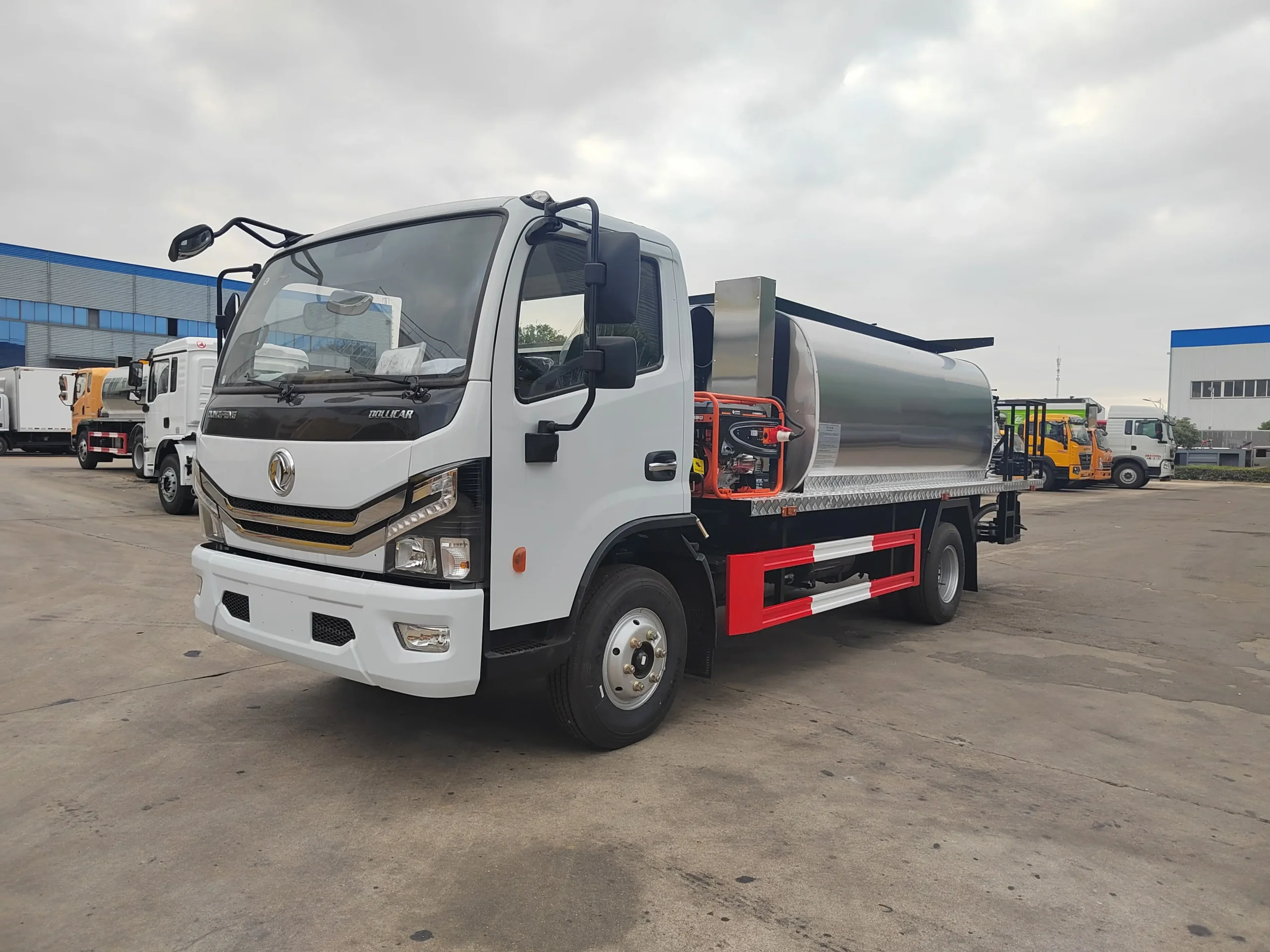
An asphalt distributor, also called a bitumen sprayer or bitumen distributor truck, applies liquid binder to a prepared surface through a spray bar or hand lance.
Depending on its configuration and approved binder compatibility, it may be used for tack coats, prime coats, surface dressing and other road maintenance applications.
Buyers should specify the actual material rather than simply requesting a machine “for asphalt.” Hot paving bitumen, bitumen emulsion and polymer-modified binder can require different pumping, temperature control and cleaning arrangements.
How Do You Choose the Right Tank Capacity?
Start with the area to be sprayed between refills:
Required spray volume (L) = road length (m) × spray width (m) × applied liquid rate (L/m²)
For example, assume a project requires:
-
Road length: 2,000 m
-
Spray width: 5 m
-
Applied liquid rate: 0.8 L/m²
The calculated liquid requirement is:
2,000 × 5 × 0.8 = 8,000 L
That is the theoretical requirement for the specified area. It does not mean a nominal 8,000L tank will necessarily complete the job in one load. Confirm the permitted filling level, usable discharge volume, operating allowance and legal payload.
The application rate in this example is illustrative. Use the rate approved for your project and binder.
Theoretical Coverage: 6,000L vs 8m³
An 8m³ tank has a nominal volume of 8,000 L.
The table below assumes the entire stated volume is usable and the applied liquid rate is 0.8 L/m².
| Nominal volume | Theoretical area | Theoretical length at 5 m width |
|---|---|---|
| 6,000 L | 7,500 m² | 1,500 m |
| 8,000 L | 10,000 m² | 2,000 m |
Actual coverage depends on usable volume, the approved application rate and site operation.
A larger tank becomes more useful when refill locations are distant. For nearby, fragmented jobs, maneuverability and setup time may matter more than the additional volume.
When Is a Compact Asphalt Distributor a Better Choice?
A lightweight compact asphalt distributor can be worth considering for narrow access roads, small maintenance areas and sites where a larger vehicle is difficult to position.
Before selecting a light-duty machine, check:
-
Loaded vehicle weight and individual axle loads
-
Turning space and site access
-
Minimum controllable spray width
-
Pump operating range at the required binder viscosity
-
Heating, circulation and cleaning arrangements
“Compact” describes the equipment’s size or layout. It does not establish its spray accuracy or suitability for a particular binder.
A hand lance can help around edges and obstacles, but its output should not be assumed equivalent to a calibrated spray bar over a full road lane.
What Does an Intelligent Bitumen Distributor Actually Control?
A speed-linked control system adjusts binder delivery as vehicle speed changes, within its designed operating range.
The relationship can be expressed as:
Required flow (L/min) = applied rate (L/m²) × active spray width (m) × travel speed (m/min)
For an illustrative operating point:
-
Applied liquid rate: 0.8 L/m²
-
Active width: 5 m
-
Travel speed: 30 m/min
The required delivered flow is:
0.8 × 5 × 30 = 120 L/min
If travel speed falls while flow remains unchanged, more liquid is applied per square metre. If speed rises without a corresponding flow increase, less is applied.
When comparing an intelligent bitumen distributor with a simpler machine, ask how it measures speed, controls delivery and responds when nozzle sections are switched off.
Also ask for its minimum stable spraying speed, calibration procedure and documented acceptance test. A touchscreen or PLC brand alone does not establish application accuracy.
Is a 5 m Spray Width Enough?
A distributor’s maximum spray width should match the project, but buyers also need to understand how the machine performs at narrower settings.
For a 5 m width asphalt distributor, confirm:
-
Whether 5 m is the effective working width
-
How spray width is adjusted
-
Whether nozzles or sections can be controlled individually
-
How delivered flow changes when active width changes
-
How nozzle spacing, spray angle and bar height are set
-
How transverse distribution is checked
Request a demonstration at the width and binder conditions relevant to your work. A maximum-width specification alone does not demonstrate an even spray pattern.
Applied Emulsion Rate and Residual Binder Rate Are Different
This distinction matters when estimating tank coverage.
The applied emulsion rate includes the liquid sprayed onto the road. The residual binder rate refers to the binder remaining after the emulsion’s water has separated and evaporated.
For a simplified mass-based example:
Applied emulsion rate = required residual binder rate ÷ residual binder mass fraction
If a specification requires 0.30 kg/m² of residual binder and the emulsion contains 60% residual binder by mass:
0.30 ÷ 0.60 = 0.50 kg/m² of emulsion
This result is in kg/m². Converting it to L/m² requires the appropriate emulsion density.
Before calculating coverage, confirm whether the project specification refers to applied liquid or residual binder, whether it uses mass or volume, and whether any approved dilution is included.
Match the Heating and Pumping System to the Binder
Do not select one operating temperature for every material.
Ask the binder supplier for the recommended storage, handling and application conditions. Then confirm that the distributor’s tank, pump, pipework and spray system are suitable.
For hot bitumen, compare insulation, temperature measurement, circulation and heating controls. For emulsion, confirm the permitted temperature and handling requirements. For modified binder, confirm viscosity limits and any additional circulation or agitation requirements.
Excessive heating should not be treated as a substitute for correct equipment selection. Eurobitume recommends managing exposure through good temperature control and keeping material temperatures as low as practically possible.
Reference: Eurobitume — Health, Safety and Environment
Check the Chassis Before Comparing Prices
A nominal tank volume is not a payload approval.
Approximate binder mass is:
Binder mass (kg) = loaded volume (L) × density at the relevant temperature (kg/L)
The complete loaded vehicle also includes the chassis, distributor equipment, fuel, personnel and accessories.
For an imported distributor truck, confirm local registration requirements, axle limits, steering configuration, emissions requirements and chassis parts support before ordering.
For equipment mounted on a locally sourced chassis, request a mounting assessment covering dimensions, weight distribution and compatibility.
How Should Buyers Compare Suppliers?
Ask each supplier to quote against the same operating requirements. Otherwise, a lower price may reflect a different chassis, smaller usable capacity or fewer included functions.
Useful comparison documents include:
-
A configuration-specific technical datasheet
-
A tank and chassis weight breakdown
-
A spray-system calibration and acceptance procedure
-
Binder compatibility and operating limits
-
Maintenance instructions and recommended spare parts
-
Warranty scope and service arrangements
-
Delivery terms and the exact supply boundary
A demonstration using a comparable binder and operating condition is more useful than a general claim of “high precision.”
Feiteng Equipment Options to Review
Feiteng’s published range includes the LS Series 6,000L bitumen sprayer and the RHD 6,000L intelligent bitumen distributor truck.
Use their product information as a starting point, then request a configuration-specific quotation. Confirm the included chassis or mounting arrangement, usable capacity, spray width, control functions and binder compatibility in writing.
If your project requires an 8m³ asphalt distributor, state that requirement explicitly and ask the supplier to confirm availability and chassis suitability.
Explore the Feiteng bitumen sprayer range.
اکثر پوچھے گئے سوالات
Is an 8m³ asphalt distributor always better than a 6,000L model?
It offers more nominal tank volume, which can reduce refill frequency. The better choice depends on daily work volume, refill distance, site access and legal loaded weight.
Can one distributor spray hot bitumen and emulsion?
Some configurations are designed for multiple binder types. Confirm compatibility, operating conditions, cleaning and changeover procedures for the exact machine and materials.
Does intelligent control eliminate calibration?
No. Speed-linked control helps regulate delivery, but its performance still depends on calibration, sensors, nozzle condition, binder properties and correct operation.
What information is needed for an accurate quotation?
Provide the destination country, application type, binder specification, required rate and units, road width, expected daily area, refill distance and preferred tank capacity. Include chassis and steering requirements where applicable.
Request a Configuration Based on Your Project
Send Feiteng your binder specification, target application rate, working width, daily spraying area and destination requirements.
These details provide a practical basis for comparing tank capacity, spray controls and vehicle configuration—and for obtaining a quotation that reflects the work your distributor must perform.
 اردو
 English
 Deutsch
 Español
 Tiếng Việt
 العربية
 Français
 Português
 Русский
 हिन्दी
 বাংলা
 Українська
 Bahasa Indonesia