






A bitumen pump can have the correct rated flow and differential pressure yet still perform poorly if the suction side of the system is badly designed.
Symptoms such as unstable flow, abnormal noise, vibration, reduced capacity, high motor load or intermittent loss of discharge are often blamed on the pump itself. In reality, the problem may originate between the storage tank and the pump inlet.
This guide explains how NPSH, bitumen viscosity, temperature, tank level, suction-pipe diameter, filters and pump location affect hot-bitumen pump performance.
Why the Suction Side Is Different from the Discharge Side
The pump can generate discharge pressure, but it cannot force liquid into its own inlet.
Material must reach the pump because sufficient pressure is available at the suction connection.
If suction resistance becomes too high, pump performance deteriorates even when the discharge system is correctly designed.
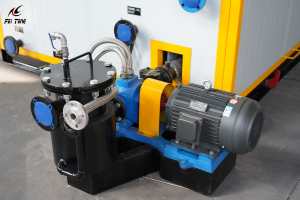
What Is NPSH?
NPSH means Net Positive Suction Head.
Two terms are important:
- NPSHa: Net Positive Suction Head available from the actual system
- NPSHr: Net Positive Suction Head required by the pump under specified operating conditions
For reliable operation, the available suction condition must exceed the pump requirement with an appropriate engineering margin.
A conceptual form of NPSHa is:
NPSHa = absolute pressure head + static liquid head − suction-line losses − vapour-pressure head
The exact calculation and required margin should follow the pump manufacturer’s method and the actual fluid properties.
Why Hot Bitumen Requires Special Attention
Bitumen creates a different suction problem from a low-viscosity liquid.
Even when vapour-pressure cavitation is not the dominant limitation, high viscosity can create substantial suction-line resistance.
Possible problems include:
- Insufficient inlet pressure
- Excessive suction friction
- Air entering through joints or seals
- Partially blocked filters
- Cold bitumen restricting the inlet
- Gas or vapour pockets at high points
- Poor tank outlet geometry
Therefore a noisy or starved hot-bitumen pump should not automatically be diagnosed as conventional cavitation without inspecting the complete suction system.
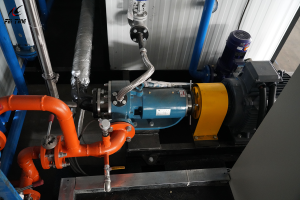
Factor 1: Tank Liquid Level
If the pump is located below the tank liquid level, the static liquid head assists pump suction.
As the tank level decreases, this available head decreases.
A system that works perfectly with a full tank may therefore become unstable near the minimum operating level.
The design should be checked at the lowest intended liquid level, not only when the tank is full.
Factor 2: Pump Elevation
Whenever practical, hot-bitumen transfer pumps often benefit from a flooded-suction arrangement.
Mounting the pump substantially above the available liquid level makes suction more difficult, especially with highly viscous material.
Project layout should therefore consider pump elevation during the equipment-design stage instead of placing the pump wherever space remains.
Factor 3: Suction Pipe Diameter
A suction pipe that is too small increases velocity and friction loss before the liquid reaches the pump.
The suction line may therefore require a different design criterion from the discharge line.
Check:
- Actual internal diameter
- Required flow
- বিটুমেনের সান্দ্রতা
- Pipe length
- তাপমাত্রা
- Number of fittings
For general bitumen-pipeline sizing principles, see:
অ্যাসফল্ট মিক্সিং প্ল্যান্টের জন্য বিটুমেন পাইপলাইনের ব্যাস কীভাবে গণনা করবেন
Factor 4: Suction Pipe Length
The longer the suction route, the more resistance the pump must overcome before material enters the inlet.
Whenever possible, the suction line should be:
- Short
- Direct
- Properly heated
- Properly insulated
- Free from unnecessary restrictions
Moving the pump closer to the tank can sometimes improve reliability more effectively than selecting a larger motor.
Factor 5: Bitumen Temperature and Viscosity
Temperature is often the most important operating variable.
As bitumen cools, viscosity rises. Higher viscosity increases suction-line friction and may dramatically change the pump inlet condition.
This is why:
- The tank outlet should remain hot
- The suction pipe should be heated where required
- The pump casing should be preheated before startup
- Valves and filters should not become cold spots
A pump that starts easily at the correct operating temperature may become impossible to start after material cools inside the suction line.
Factor 6: Filters and Strainers
A suction-side filter introduces additional resistance.
As the filter accumulates impurities, this resistance increases.
Possible symptoms include:
- Reduced pump flow
- Increased noise
- Unstable discharge
- Higher vacuum or lower inlet pressure
Filter area and maintenance frequency should therefore match the expected bitumen cleanliness and flow rate.
Factor 7: Suction Valves and Fittings
Every partially closed valve, elbow, reducer or other restriction adds resistance.
Common problems include:
- Valve not fully open
- Incorrect valve selection
- Too many elbows close to the pump
- Abrupt reductions
- Blocked check valves
Suction piping should generally be simpler than the discharge network.
Factor 8: Air Leakage
A pump can draw air through a joint even when hot bitumen does not visibly leak out.
Inspect:
- Flanges
- Gaskets
- Threaded connections
- Pump seals
- Valve packing
Entrained air can produce unstable flow and noise that may be mistaken for cavitation.
Factor 9: Gas and Vapour Pockets
Piping geometry can create high points where gas accumulates.
Where system design permits, suction lines should avoid unnecessary high points and arrangements that trap air or vapour.
The tank outlet and piping arrangement should also avoid vortexing or drawing gas at low tank level.
Recognizing Possible Suction Problems
Typical symptoms include:
- Pump is noisy after startup
- Flow is lower than expected
- Discharge pressure fluctuates
- Pump loses prime or material supply
- Vibration increases at higher flow
- Performance improves when tank level rises
- Performance worsens when bitumen cools
- Cleaning the suction filter temporarily restores flow
These symptoms do not prove one single cause, but they point toward the suction system.
A Practical Troubleshooting Sequence
- Confirm actual bitumen temperature.
- Confirm tank level.
- Verify all suction valves are fully open.
- Check the suction filter or strainer.
- Verify the pump and suction line are fully preheated.
- Inspect for air leakage.
- Check pump rotation and speed.
- Compare actual flow with the design duty.
- Measure inlet and discharge conditions if suitable instrumentation is available.
- Compare the result with the pump manufacturer’s suction requirements.
Why Increasing Motor Power Does Not Solve Poor Suction
If the pump cannot receive enough material, installing a larger motor does not create additional suction head.
The correct solution may instead involve:
- Reducing suction resistance
- Increasing pipe diameter
- Shortening the pipe
- Improving heating
- Cleaning the filter
- Lowering the pump elevation
- Increasing available tank level
Modified Bitumen and Rubber Bitumen
SBS and crumb-rubber modified binders can impose greater suction resistance because of their viscosity and material characteristics.
For these materials, verify:
- কার্যকরী তাপমাত্রায় প্রকৃত সান্দ্রতা
- Pump suitability
- Minimum required line temperature
- Suction diameter
- ফিল্টার কনফিগারেশন
- Potential particle or contamination issues
Startup Procedure Matters
One of the most damaging practices is attempting to force-start a pump containing cold or highly viscous bitumen.
Before startup:
- Preheat the pump
- Preheat the suction line
- Confirm tank temperature
- Open the required valves
- Verify receiving capacity
- Confirm pump direction
The exact procedure should follow the equipment manufacturer’s operating instructions.
সচরাচর জিজ্ঞাস্য
What causes cavitation in a bitumen pump?
Insufficient available suction pressure is one possible cause. In hot-bitumen service, high viscosity, restricted suction lines, low tank level, blocked filters, cold material and air ingress can also create similar symptoms.
Should the bitumen pump be below the tank?
A flooded-suction layout is often beneficial for viscous materials, but final arrangement depends on the tank, pump and project design.
Why does the pump work when the tank is full but fail when the level is low?
A higher tank level provides more static suction head. If the system is already close to its suction limit, reducing tank level can expose the problem.
Can a blocked filter cause cavitation-like symptoms?
Yes. A dirty suction filter can substantially increase inlet resistance and reduce pump capacity.
উপসংহার
Reliable bitumen pumping depends as much on the suction system as on the pump itself.
A useful design sequence is:
Tank Level → Temperature → Viscosity → Suction Diameter → Suction Loss → NPSH → Pump Verification
FEITENG can coordinate tank outlets, heated suction lines, filters, pumps and circulation systems for complete bitumen handling packages.
হোয়াটসঅ্যাপ: +86 15335447006
ইমেইল: [email protected]
ওয়েবসাইট: www.bitumenmachine.com
 বাংলা
বাংলা  English
  Deutsch
  Español
  Tiếng Việt
  العربية
  Français
  Português
  Русский
  हिन्दी
  Українська
  Bahasa Indonesia
  اردو
اردو