







 Get Price
 Online consulting
Description
The Industrial Electric Thermal Oil Heater is a compact, purpose-built thermal oil circulation heating system engineered specifically for asphalt and bitumen processing applications. Rather than attempting to replace large fuel-fired boilers, this system is designed to solve a critical yet often underestimated problem in asphalt plants: localized heating for pumps, valves, unloading systems, and short-distance pipelines.
In conventional asphalt plant operations, operators are frequently forced to start a high-capacity fuel-fired boiler—often exceeding 1,000,000 kcal—simply to unblock a single DN80 valve or preheat a bitumen pump. This “sledgehammer-to-crack-a-nut” approach leads to excessive fuel consumption, long preparation times, and unnecessary thermal stress on the main heating system.
The Industrial Electric Thermal Oil Heater eliminates this inefficiency by functioning as an independent Micro Thermal Station. Operating separately from the main boiler, it uses electric energy to rapidly heat and circulate thermal oil, delivering heat precisely where it is needed. This makes it possible to maintain or restore bitumen fluidity without activating the entire plant heating system.
The unit is primarily used for bitumen pump jackets, valve heat-tracing systems, unloading pit coils, and auxiliary pipelines. By maintaining stable temperatures—typically between 160°C and 200°C—it effectively prevents cold-start pump seizure, valve solidification, and pipeline blockage. As a result, it serves as a critical cold-start safeguard for asphalt mixing plants, emulsified bitumen production lines, and polymer-modified bitumen facilities.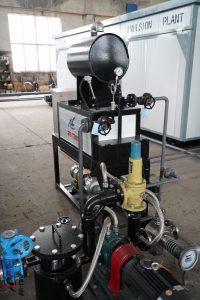
Main Parameters
| Item | Specification | Engineering Interpretation |
|---|---|---|
| Heating Power | 20–21.5 kW | Optimized for localized heat tracing, balancing fast heating response with manageable electrical load |
| Thermal Oil Pump Flow Rate | 12.5 m³/h (reference value) | Ensures turbulent oil flow, improving heat transfer and preventing local overheating or oil coking |
| Temperature Control Range | Ambient – 300°C | Factory default typically set at 200°C, fully covering bitumen pumping and circulation requirements |
| Inlet / Outlet Size | DN25 (1 inch) | Standard flange size compatible with most bitumen pump and valve heating jackets |
| Power Supply | 380V / 50Hz / 3-Phase (3P + N) | Industrial-grade power configuration, stable and widely available |
| Control Mode | PID automatic temperature control | Automatic power modulation with upper-limit stop and lower-limit restart |
| Heating Medium | Thermal oil (organic heat transfer fluid) | Qualified thermal oil only; water contamination strictly prohibited |
| System Configuration | Heater, circulation pump, expansion tank, control cabinet, sensors | Fully integrated system, no external auxiliary equipment required |
Main Features
1. Targeted Local Heating Instead of Full-System Heating
The system is designed exclusively for localized thermal demand, supplying heat only to critical components such as pumps, valves, and pipelines. With an installed power of approximately 20 kW, it maintains continuous bitumen fluidity while consuming only a fraction of the energy required to operate a large fuel-fired boiler. This results in significant reductions in operating expenditure and startup time.
2. Independent Micro Thermal Station for Flexible Operation
Functioning as a standalone heating unit, the Industrial Electric Thermal Oil Heater can operate independently when the main boiler is shut down. This capability is particularly valuable during:
-
Cold-weather startup
-
Intermittent production schedules
-
Maintenance and emergency recovery operations
The system allows operators to prepare key components for operation without activating the entire plant heating infrastructure.
3. High-Efficiency Immersion Electric Heating Design
The heater employs high-efficiency immersion electric heating elements that directly heat the circulating thermal oil. This direct-contact heating method ensures rapid thermal response, uniform temperature distribution, and minimal energy loss, making it ideal for short-cycle and on-demand heating scenarios.
4. Precision PID Temperature Control Logic
An industrial-grade PID controller with SV/PV dual display continuously monitors return oil temperature and dynamically adjusts heating output. This precision control ensures that operating temperatures remain stable within the desired range while preventing:
-
Localized overheating
-
Accelerated bitumen aging
-
Thermal oil degradation
5. Integrated Safety Interlock System
To eliminate risks associated with operator error, the system incorporates a strict safety interlock logic based on the principle of “Pump First, Heat Second.” Electric heating elements can only be energized once thermal oil circulation is confirmed. This design effectively prevents dry firing, heater tube burnout, thermal oil coking, and potential fire hazards.
6. Compact Skid-Mounted Integrated Structure
All major components—including the expansion tank, oil reservoir, circulation pump, heating unit, electric control cabinet, and valve group—are mounted on a single compact skid. On-site installation requires only pipeline connections and electrical wiring, allowing for fast commissioning, easy relocation, and minimal footprint.
7. Critical Protection for High-Value Bitumen Equipment
By preheating solidified bitumen before startup, the system prevents excessive mechanical load on pumps, motors, and couplings. In practical asphalt engineering, the majority of pump and motor failures are caused by cold starts. This unit therefore acts not merely as a heater, but as an insurance device that protects high-value equipment and ensures continuous, reliable production.
Your inquiry will be replied within 24 hours.
 English
  Deutsch
  Español
  Tiếng Việt
  العربية
  Français
  Português
  Русский
  हिन्दी
  বাংলা
বাংলা  Українська
  Bahasa Indonesia
  اردو
اردو